what mechanism is used in a laser printer to permanently fuse the toner to the paper?
Now that you know the major parts of the printer, here's a quick survey of how the laser printer works and the components needed to handle each job. (Some of these tasks occur simultaneously in actual printing.)
Communicating
The following sequence occurs every bit calculator-to-printer communication is established:
- The operating system sends a request to the printer and is informed that the printer is online and ready to accept information.
- The PC starts sending data.
- During the press procedure, the printer-if it is able to handle bidirectional communications-informs the computer of whatever bug encountered while handling the print job so the user can accost the complaint. These messages might include an out-of-newspaper status, paper jam, or low toner.
- Afterward the entire task has been sent, the printer acknowledges the receipt of all data and waits for the next request.
Many printers can shop more than than one task, and network printers oft accept difficult disk drives that can concord mutual jobs to let the printer to impress without beingness continued to a PC.
Warming Upwardly
The printer might delay accepting the job or printing the first page while information technology warms upwards its rollers and the imaging drum.
Raster-Prototype Processing
The image (text and graphics) to be fabricated is converted into a series of raster lines that tin can be drawn much the same mode every bit the image is formed on the PC's monitor. The data is stored in retentiveness, waiting for the send command.
Paper Feeding
The printer moves a sheet of paper from the proper tray onto a serial of rollers, through the imaging and fixing areas, and to the output hopper.
Drum Cleaning and Charging
Any residual toner from past jobs is scraped from the printer'due south photosensitive drum. A fine wire (the primary corona) produces a negative electrical accuse beyond the entire face of the pulsate. The prototype is set in raster lines as a serial of fine dots on the pulsate.
Imaging the Pulsate
The data from the raster-image processor is read from memory and sent to the print engine, one line at a time. The light amplification by stimulated emission of radiation sets a positive charge in the areas of the image to exist filled with toner.
Transferring Toner to the Pulsate
A moving-picture show of fine plastic power is placed on the toner transfer roller, which is turning close to the photosensitive pulsate. This toner is then attracted to the positively charged areas of the drum.
Transferring Toner to the Newspaper
The corona wire places a positive electrical charge on the newspaper as it moves shut to the drum. The toner is attracted to the page, forming an paradigm.
Fusing the Toner
The page passes through a pair of rollers. The roller on the side toward the toner that has been placed on the page is heated but plenty to melt the plastic toner particles onto the page without smearing. The roller on the other side supplies the needed pressure.
Finishing and Output
Subsequently the toner has been fused to the newspaper, the side by side step is usually to transport the folio to the output tray. However, if other options-such as a duplexer or collator-are available, the page might be routed through a separate path, based on the options for the current print task, and so sent out to the tray. Figure 12.3 shows the process of light amplification by stimulated emission of radiation printing.
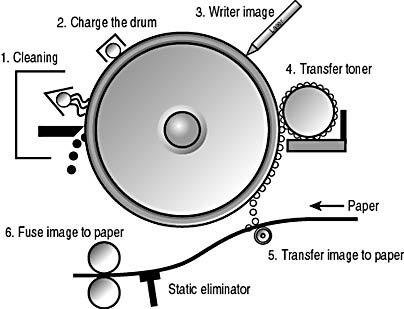
Figure 12.3 The light amplification by stimulated emission of radiation printing process
Laser Printer Resolution
The quality of a laser printer is direct related to its resolution, given in dpi. Horizontal resolution is determined by how fine a line tin be focused on the pulsate past the light amplification by stimulated emission of radiation (the number of dpi across the page); vertical resolution is based on the increment by which the photosensitive drum is turned for each pass of the raster line.
In about cases, resolution is given every bit a single number, indicating that both the horizontal and vertical increments are the same. The first light amplification by stimulated emission of radiation printers offered 300 dpi resolution; printers today commonly offer 600 and 1200 dpi. The college the number, the sharper the detail and the more retentivity required to prototype the folio. In general, the human being eye cannot distinguish between 600 dpi and 1200 dpi text on bond paper, but the college resolution does do good images and drawings by providing a smoother transition between tones and curved lines.
TIP
Many light amplification by stimulated emission of radiation printers offer a "toner saver" that uses a lower-resolution draft mode, thereby extending the life of a toner cartridge by placing less toner on each page.
Troubleshooting Light amplification by stimulated emission of radiation Printer Problems
Properly installed laser printers are quite reliable when operated and maintained within the guidelines set past the manufacturer. Still, given the combination of mechanical parts, the variety of steps in printing, and the innovative ways some users utilise the printer, bug do occur. The following table lists a few issues that can be encountered with laser printing and their possible causes.
Ghost images announced at regular intervals on the printed page.
Photosensitive pulsate is non fully discharged. Previous images used likewise much toner, and the supply of charged toner is either insufficient or non adequately charged to transfer to the drum.
Light ghosting appears on pages.
Previous page(s) used too much toner; therefore, the drum could not be properly charged for the image (called developer starvation).
Dark ghosting appears on pages.
Drum is damaged.
Page is completely black.
Chief corona, laser scanning module, or primary central board has failed.
Random blackness spots or streaks appear on page.
Pulsate was improperly cleaned; remainder particles remain on drum.
Marks announced on every folio.
Pulsate is damaged and must be replaced.
Printing is too low-cal (appears in a column-like streak).
Toner is depression.
Retentivity overflow error.
Not enough RAM-printing resolution too loftier.
Characters are incomplete.
Print density is wrong. (Adjust the darkness setting on the toner cartridge.)
Mass of melted plastic is spit out.
Incorrect transparency material is used (see section on transparency, later in this lesson).
Pages are creased.
Paper type is wrong.
Characters are warped, overprinted, or poorly formed.
There is a problem with the paper or other media or with the hardware. (For media: avert paper that is too crude or besides shine. Newspaper that is too rough interferes with fusing of characters and their definition. If the paper is too smoothen, it can feed improperly, causing distorted or overwritten characters. For hardware: run the cocky-test to cheque for connectivity and configuration bug.)
Afterwards clearing a paper jam from the tray, printer still indicates a paper jam.
Printer has non reset. (Open and close the cover.)
Newspaper continues to jam.
Problem with the pickup area, turning expanse, and registration (alignment) area. (Await for worn parts or debris.)
by updated
Source: https://www.brainbell.com/tutors/A+/Hardware/The_Mechanics_of_Laser_Printing.htm
0 Response to "what mechanism is used in a laser printer to permanently fuse the toner to the paper?"
Post a Comment